Liquidations
Liquidations are a product feature, not an afterthought. They are the growth channel: every one is a headline, and the mechanics are built so that the headline is always fair.
When a position is liquidated
A position is liquidated when its margin plus unrealised PnL, measured at the index price, falls to the maintenance fraction of its notional. The check runs on every keeper sample. Attached stop losses fire on the mark and usually get there first; the liquidation is the backstop.
What happens
- The position is closed on the curve at the curve's average price.
- A liquidation fee of 1% of notional is taken from whatever margin remains, never more than remains.
- What is left of the margin is returned to the account. If the close leaves a shortfall, the insurance fund absorbs it; the account never goes below zero.
- The fill shows as liquidation in trade history and the account's liquidation count goes up on the leaderboard.
Fees and the insurance fund
Liquidation fees and any shortfall flow through the insurance fund, whose balance is public on the liquidations page. In demo mode it is paper like everything else; on the live venue the operator seeds it with house money from the admin page, and it is the first line against bad debt.
The public feed and the bot
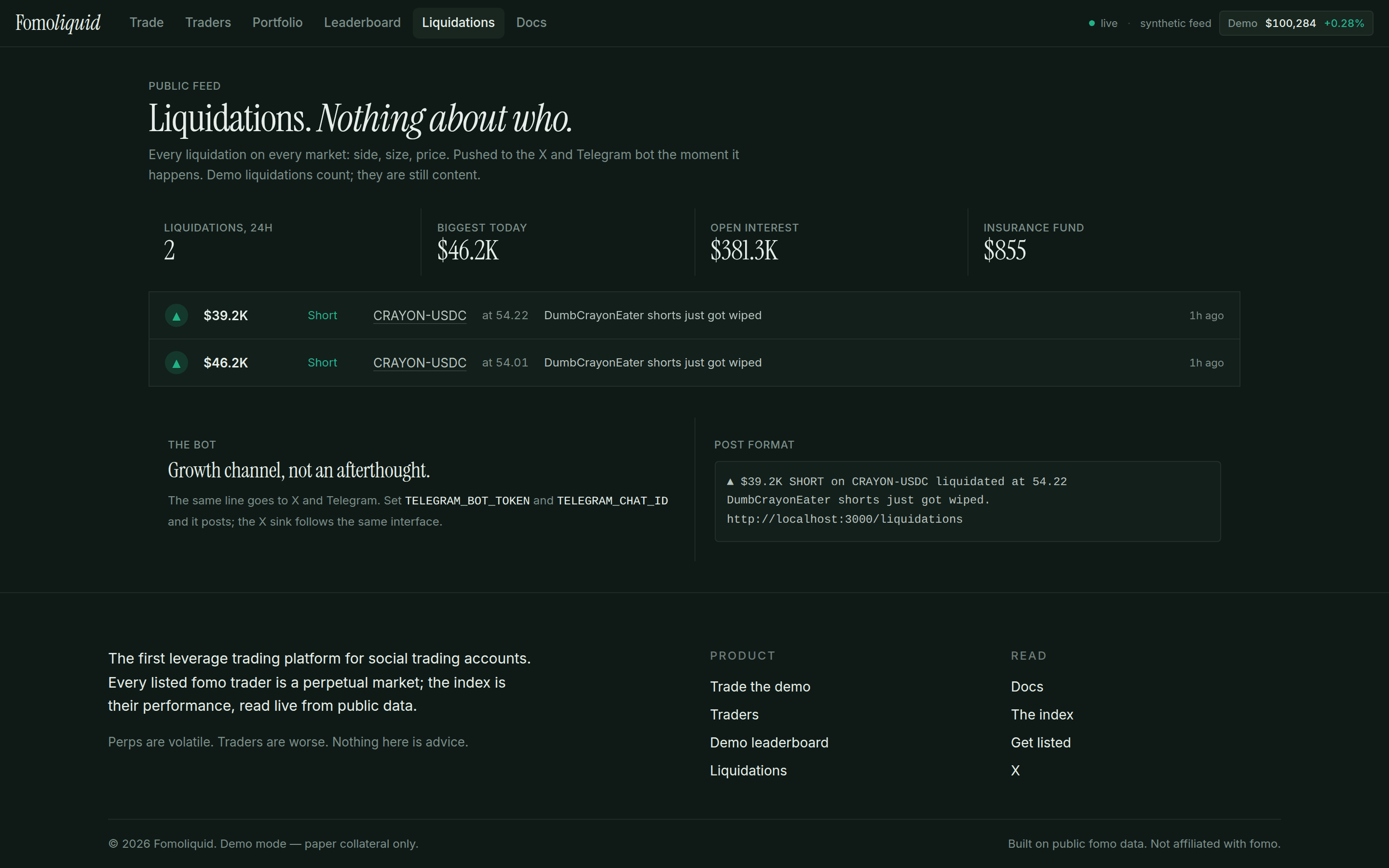
Every liquidation, demo included, is pushed to the feed and to the X and Telegram bot the moment it happens, with the market, the side, the size and the price. Never the account. The post format is shown on the liquidations page; a deployment turns the Telegram sink on with two environment variables.
Why the index and not the mark
A vAMM is a thin curve by design. If liquidations read the mark, a large order could push the mark through someone's liquidation price and back within one tick. Reading the index instead means a liquidation always reflects the trader's actual performance, never the depth of the book. Unrealised PnL still displays at the mark, so the two can differ by a little; the positions tab shows both.
The liquidation price shown everywhere is the index level at which the position is closed. See the formula.